Chambers, sponsorships, community organisations and local press: found, scored, contacted and tracked, city by city, with a browser agent for the sites that only take a form.
Start freeNational guest posting rewards volume. Local link building rewards relevance to one city, and the supply of good targets in any given town is small and finite. That makes qualification and record keeping more important, not less: you cannot afford to burn the only chamber of commerce with a careless email, and you cannot afford to skip the youth league because it wanted a sponsor form instead of an editor's address.
Open the client environment, choose the local backlink campaign type in Discover, enter the city, and LinqDesk searches live Google results for chambers, sponsorship pages, community organisations and local directories in that market, then scores each domain and hides anything already in your pipeline. Local discovery uses its own rules: a chamber, league or city page passes on being real, local and clean rather than on traffic.
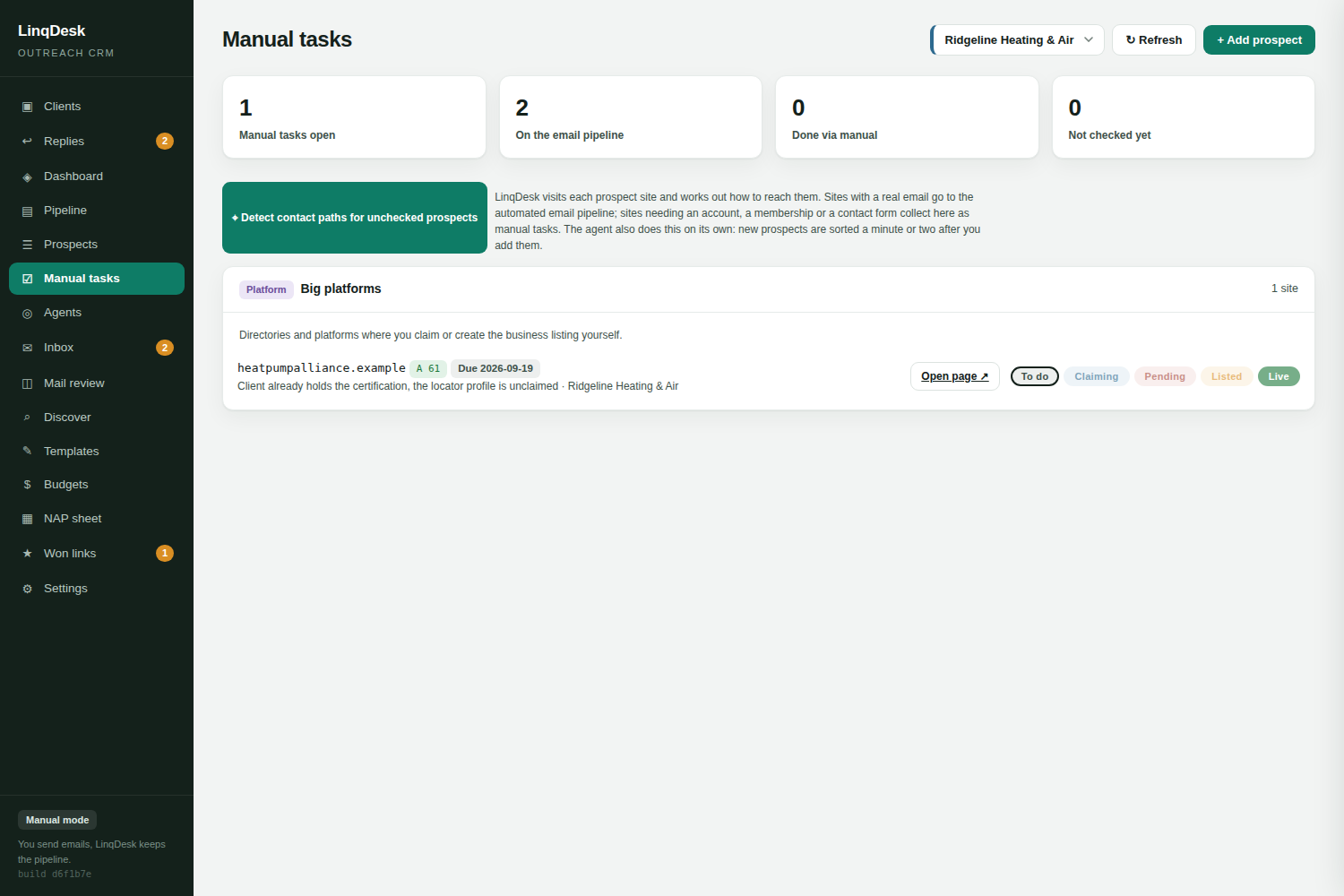
Every kept site is then opened to find the way in. A membership page, a sponsor application, a contact form or a claimed listing becomes that prospect's contact path. From there the workflow splits:
When the link goes live, the sponsorship fee is recorded against the client's monthly budget, and the weekly monitor keeps checking that the listing still carries a followed link.
Local prospects are finite, so LinqDesk keeps a do-not-contact list per workspace. Once an organisation says no, nobody on your team emails them again by accident.
Paste the client's NAP tab from Google Sheets once. Business name, phone, address, city, services, owner, founding year, unique selling point and the Google Business Profile link fill the client profile and are re-read on a schedule, so an edit in the sheet shows up here by itself. The same profile personalises every email and fills every form. The browser agent gets the whole sheet and the GBP link, never the login.
A realistic target for a suburban service business is 4 to 8 local links a month. Discover finds and measures the candidates, the pipeline agent tops the month up when it is short, the engine and the browser agent do the contacting, and the report at month end lists each placement with its cost and live URL. The client sees their chamber listing, their sponsor logo on the league page and their spotlight in the community blog, all in one branded PDF.
The client is a licensed plumber with a $600 monthly link budget and a target of six links. Discover for "plumbing" in their city returns the chamber, two business associations, a youth baseball league with a sponsor page, a home-and-garden community blog, the regional plumbing contractors association, a county permit-holder directory and a manufacturer's certified installer locator the client already qualifies for.
Triage sorts them. The blog and the association have editor addresses and go to the email pipeline. The chamber, the league and the associations take forms and land in Manual tasks. The county page and the locator are claimed listings, also Manual tasks. The browser agent fills each form from the NAP profile and, in Ask me first mode, shows you the filled fields before anything is submitted.
The blog editor replies asking $150 for a sponsored spotlight. The asking price lands on the prospect. The client's max cost per link is $150, so the replies agent agrees and the orders agent writes the brief. The league wants $300 for the season, over the limit, so it stops for you. You approve it because the sponsor page has real authority, and the fee is recorded against the budget. At month end the report lists six live links with their costs, and the budget table shows $30 carried into next month.
Links that a real local person could plausibly click: the chamber of commerce, local business associations, sponsored community events and teams, local charities, nearby trade associations, and local news coverage.
For most suburban service markets, a steady 4 to 8 relevant local links a month for six months moves map and organic rankings more reliably than a one-off burst of fifty.
A genuine sponsorship of a real local organisation, where the listing exists because you actually sponsor them, is normal marketing. Buying a link on a page of unrelated paid links is not.
That is why LinqDesk gives every prospect a contact path. A chamber with a membership form or a league with a sponsor application lands in Manual tasks, and the browser agent fills the form from the client's NAP profile: business name, phone, address, services, owner. You approve the submission or let it send.
Yes. Local backlink discovery uses its own rules: a chamber, league or city page passes on being real, local and clean rather than on traffic, and .gov pages are kept.
Create your workspace, connect a mailbox, add your first client. Five minutes.
Start free